Figure 1.19—AI Governance Stakeholders
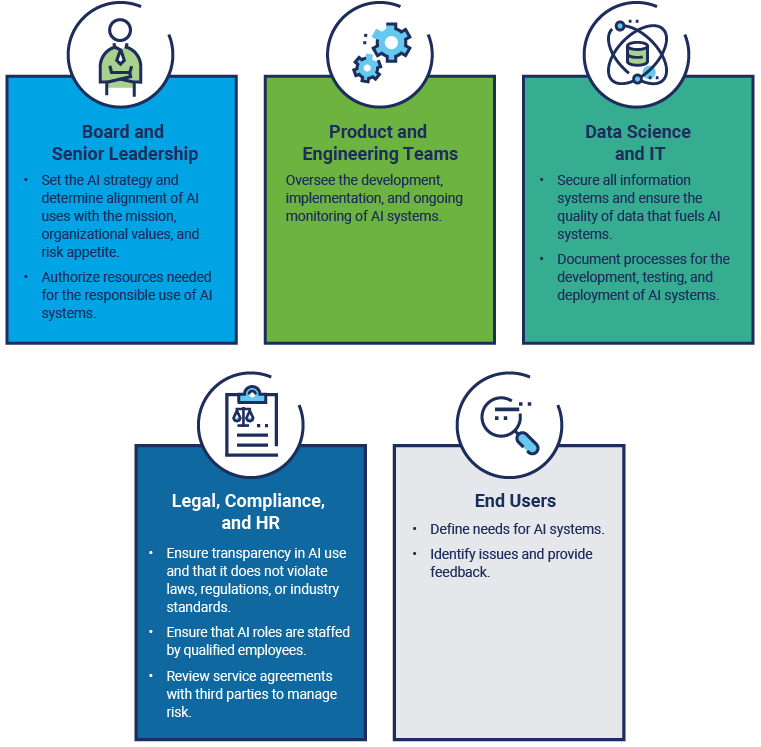
Source: Alvero, K.M.; Kouzehkanani, R.; “The Power of Accountability in AI Governance,” ISACA Journal, vol. 3, 2025, link
The need for clear ownership of AI models, solutions, and decisions is crucial. Following the release of ChatGPT, an expectation was that a chief AI officer (CAIO) role should be established in enterprises leveraging AI solutions. This has led to existing roles filling the gaps needed for AI oversight. Effective AI governance includes oversight mechanisms that address risk, such as bias, data drift, information security, data governance, system performance and degradation issues, privacy infringement, and misuse, while fostering innovation and building trust. An ethical, AI-centered approach to AI governance involves a diverse range of stakeholders, including AI developers, users, policymakers, and ethicists, ensuring that AI-related systems are developed, used, and continuously monitored in accordance with the values and norms of the society or jurisdiction impacted by them.
Understanding AI-related roles and responsibilities is an important step for any organization developing or implementing AI solutions. Roles and their related responsibilities vary based on the size of the organization and its AI adoption strategy. For example, an organization that implements third-party AI solutions may not have development or operations-related roles in its IT department. Common categories of AI roles and their related responsibilities are shown in figure 1.18.
Figure 1.18—Categories of AI-related Roles and Responsibilities
| Category | Focus | Common Examples |
|---|---|---|
| Leadership and strategy | Artificial intelligence (AI) strategy roles define the vision, objectives, and implementation roadmaps for adopting AI solutions within an organization and provide guidance for the entire AI life cycle. |
|
| Developmental and operational | AI development and operational roles are responsible for the creation, implementation, and maintenance of AI solutions. |
|
| Users | AI user-related roles are the actual users of AI solutions and their supporting roles. |
|
| Governance and oversight | AI governance roles ensure security, legal, and ethical adherence of AI solutions to organizational principles and compliance requirements. |
|
Source: ISACA, ISACA AAIA Official Review Manual, USA, 2025
The responsibility of the governing body to establish goals in traditional contexts extends to both financial objectives and nonfinancial concerns, including the culture, values, and ethics of the enterprise. Organizational and governance policies are usually created and applied through a combination of controls, plans of business, strategies, job descriptions, accepted practices of professional discipline, regulations, training, key performance indicators (KPIs), and a variety of executive communications. The governing body is responsible and accountable for all the activities of an organization, and this responsibility cannot be delegated. Therefore, the governing body needs to consider the implications of any new tool, technique, or technology an organization may adopt, including AI.
The members of the governing body must demonstrate to stakeholders that their policies (and related implementation plans) are in place to govern the effective delivery of the organization’s AI products and interactions via the human resources, processes, and technologies in use. In this sense, the responsibility for the introduction of AI and its consequences is not new. However, AI has the potential to allow for new organizational objectives and to meet or expand existing ones in a more effective and efficient way.
The governing body must determine if the intended use of AI is in line with its risk appetite. The risk can change quickly. New knowledge and a proactive governance system provide an organization with the means to respond to risk, such as modifying or aborting project plans, if necessary.
As they can be held legally accountable for any bad actions executed by an AI solution, members of the governing body must ensure that practices are appropriate for the specific uses to which AI is applied within the organization. This includes the review and, when necessary, the improvement of:
When integrating AI into a project, business, or organization, it is essential to consider the perspectives and needs of stakeholders, both internal and external to the enterprise.
Best practices for addressing stakeholders’ concerns include:
By addressing these considerations, organizations can build trust, ensure success, and maximize the value of AI solutions for all involved.
Key internal stakeholders are described in figure 1.19.
Figure 1.19—AI Governance Stakeholders
Source: Alvero, K.M.; Kouzehkanani, R.; “The Power of Accountability in AI Governance,” ISACA Journal, vol. 3, 2025, link
Key external stakeholders are described in figure 1.20.
Figure 1.20—Key External Stakeholders for AI
| Stakeholder | AI Considerations |
|---|---|
| Customers and end users |
|
| Third parties (partners, vendors, etc.) |
|
| Regulators and policymakers |
|
| Society and communities |
|
Source: ISACA, ISACA AAISM Official Review Manual, USA, 2025
Creating a charter and establishing a steering committee for an AI initiative ensures clear governance, accountability, and strategic alignment. A charter formally defines the scope, objectives, and work of the AI project. It serves as a guiding document to align stakeholders and establish expectations.
Key components of an AI charter are shown in figure 1.21.
Figure 1.21—Key Components of an AI Charter
| Component | Description |
|---|---|
| Project name and description | Title: A concise name for the artificial intelligence (AI) initiative. Description: A brief overview of the initiative’s purpose and the problems it aims to solve. |
| Objectives and goals | Define specific, measurable outcomes. Examples:
|
| Scope | In scope: Activities, processes, or systems the AI initiative will impact. Out of scope: What is excluded to avoid scope creep. |
| Stakeholders | Identify key stakeholders, including:
|
| Governance structure | Define the roles of the steering committee, project sponsors, and working groups. Include reporting mechanisms and decision-making processes. Include accountability for AI change management to guide organizational adaptation and reduce resistance to AI adoption. |
| Timeline and milestones | Provide a high-level project timeline specifying key milestones. |
| Resources and budget | Outline the resources required, such as personnel, technology, data, and funding. |
| Risk management | Identify potential risk, such as ethical concerns, data quality issues, or technical challenges. Include mitigation strategies. |
| Success metrics | Define how success will be measured (e.g., return on investment [ROI], accuracy, adoption rate, key performance indicators [KPIs]). |
| Approval and authorization | Include a section for signatures from key decision-makers to formalize commitment to the business plan. |
Source: ISACA, ISACA AAISM Official Review Manual, USA, 2025
The AI steering committee provides strategic oversight, ensures alignment with organizational goals, and resolves major issues during and after the AI project life cycle. The key responsibilities of the committee are to ensure AI initiatives maintain strategic alignment and to make major decisions related to AI within an enterprise, such as budget changes, scope adjustments, risk, and challenges.
The AI steering committee ensures that AI practices are ethical and compliant with regulations and laws. This includes reviewing policies regarding AI use, data handling, and bias mitigation.
Composition of the AI steering committee should be cross-functional and include representation from the lines of business impacted by AI projects. Typically, the committee consists of:
Regularly scheduled (e.g., monthly or quarterly) meetings are needed, along with ad hoc meetings for making critical decisions.
In most IT implementations, accountability is associated with the duty to explain, justify, and take responsibility for the actions and decisions made by or related to the system.58
Additionally, several characteristics of AI make establishing accountability more challenging:59
Structured AI frameworks can assist in this task, especially by ensuring accountability is embedded into all phases of the AI life cycle. See Chapter 2 AI Life Cycle Risk Management for more information.
The use of a responsible, accountable, consulted, informed (RACI) matrix is a critical practice for clearly defining roles and responsibilities throughout the AI solution life cycle, including development, deployment, and ongoing management.
In the context of AI solutions, the RACI categories denote:
Figure 1.22 shows a sample RACI chart for an AI project. (Roles: AI Steering Committee, Chief Risk Officer, Chief Information Security Officer, Head AI Architect, Head AI Engineer, Information Security Manager, Privacy Officer.)
Figure 1.22—Sample AI RACI Chart
| Practice | AI Steering Committee | Chief Risk Officer | Chief Information Security Officer | Head AI Architect | Head AI Engineer | Information Security Manager | Privacy Officer |
|---|---|---|---|---|---|---|---|
| Design the artificial intelligence (AI) model. | I | I | A | R | R | C | C |
| Communicate the objectives, direction, and decisions made related to the AI solution. | A | R | R | ||||
| Define data classifications and information ownership. | A | R | R | C | |||
| Ensure model transparency, fairness, and explainability. | A | R | R | I | |||
| Define and communicate AI policies and procedures. | A | R | R | R | R | R |
Source: Adapted from ISACA, COBIT: Governance and Management Objectives, USA, 2018