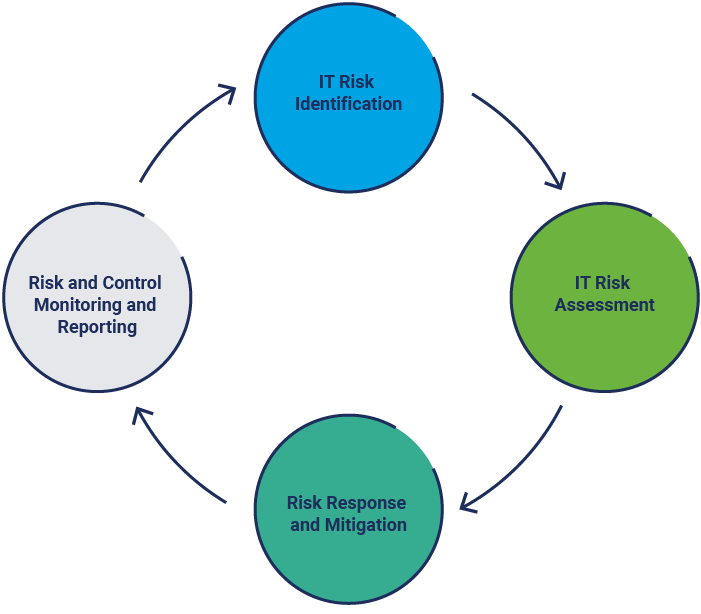
Figure 3.1—IT Risk Management Life Cycle
Source: ISACA, CRISC Official Review Manual, 8th Edition, USA, 2025
Identifying and assessing AI risk scenarios is a foundational step in managing the unique and evolving risk associated with AI systems. AI risk is inherently dynamic, shaped by rapid technological advancements, novel threat actors, and emerging vulnerabilities that differ significantly from traditional IT risk. The IT risk management life cycle remains relevant (figure 3.1) for addressing and managing risk associated with AI.
Figure 3.1—IT Risk Management Life Cycle
Source: ISACA, CRISC Official Review Manual, 8th Edition, USA, 2025
Risk identification remains an important first step for AI risk management. This starts with accurately inventorying AI use within the organization. See 2.15 AI Asset Inventory for more information. Once enterprises understand how AI is used, it can uncover risk associated with its use. AI-related threat and risk models can be leveraged to create risk scenarios that can be analyzed and used to inform risk treatment strategies for AI. This begins with understanding the AI threat landscape.
The AI threat landscape encompasses the risk, challenges, and security and privacy concerns associated with the development and use of AI solutions. The AI threat landscape is multifaceted and involves a wide range of threat actors attempting to exploit vulnerabilities in a new technology that provides exponential computing capabilities. Their goal is either to exploit the AI solution itself or leverage it to harm people, organizations, or the ecosystem.
To manage AI risk effectively, practitioners must understand the unique threat landscape introduced by AI technologies. These include both traditional cybersecurity threats and novel AI-specific threats such as:
See 3.1.1 Vulnerabilities and Attacks Specific to AI for more detail on each of these areas.
In addition to threats targeting the AI models themselves, organizations must be aware of systemic risk introduced through external dependencies and operational constraints, including:
These threats correspond to risk categories that are familiar to enterprises:
Figure 3.2 shows examples of threat actors and related AI threat scenarios.
Figure 3.2—Examples of AI Threat Actors and Scenarios
| Threat Actor | Description | AI Threat Scenarios |
|---|---|---|
| Insider threats | An organization’s own employees can leverage artificial intelligence (AI) systems intentionally or unintentionally to cause harm to the organization. |
|
| Nation states | A nation state may use AI to advance its strategic interests (e.g., for cyberespionage, surveillance, warfare). |
|
| Cybercriminals | Cybercriminals may use AI to make their attacks more effective and harder to detect. |
|
| AI developers | AI developers may create AI solutions that lack alignment with commonly agreed-upon ethical standards. |
|
Source: ISACA, ISACA AAIA Official Review Manual, USA, 2025
Recent advancements in generative AI (GenAI) models have ushered in new use cases, modalities of interaction (e.g., text prompts, voice commands, visual signs), and new threat vectors. Such a large addressable market has attracted threat actors that are intent on exploiting the weaknesses that stem from rapidly adopting new technologies with immature guidance.
As AI systems are software applications at their core, OWASP has developed a top 10 list of security issues for large language model (LLM) applications.140 Many attacks are similar to those that organizations commonly see with IT or cybersecurity programs. How OWASP ranks common LLM risk is shown in figure 3.3.
Figure 3.3—OWASP Top 10 List for Large Language Model Applications
| Attack Name | Attack Description |
|---|---|
| Prompt injection | A prompt injection occurs when an attacker uses specific prompts to alter the behavior of a large language model (LLM), often nefariously. |
| Sensitive information disclosure | Sensitive information, such as personally identifiable information (PII), is exposed due to use in the LLM. |
| Supply chain | The LLM supply chain creates risk that can leave LLMs vulnerable to tampering or poisoning that could potentially lead to model drift, such as third-party package vulnerabilities, licensing risk/terms and conditions vulnerabilities, outdated models, etc. |
| Data and model poisoning | Data poisoning occurs when data used to train and validate a model is manipulated to introduce vulnerabilities, backdoors, or biases. Models can also include risk, such as malware embedded into the system. |
| Improper output handling | Improper output handling occurs when LLM outputs are not sufficiently validated, sanitized, or handled and are then passed to other components and systems. |
| Excessive agency | As an LLM “learns,” it can gain agency, or the ability to make decisions (or perform actions or call functions to other systems) via various extensions based on prompts. |
| System prompt leakage | System prompt leakage is the risk that prompts, or the instructions used to direct the model, can contain sensitive information, such as proprietary information or the means to bypass system guardrails. |
| Vector and embedding weaknesses | Vectors and embedding vulnerabilities in retrieval augmented generation (RAG)-based LLM systems, a model adaptation technique that combines pretrained language models with external knowledge sources, expose risk in how data is handled. Exploitation can lead to unauthorized access, data leaks, manipulated outputs, and altered model behavior. |
| Misinformation | Misinformation occurs when LLMs produce false or misleading information that appears credible, often due to hallucinations in the data. |
| Unbounded consumption | Unbounded consumption occurs when an LLM enables end users to draw an excessive number of inferences, which can lead to denial of service (DoS) attacks and service disruptions, as well as financial loss and even model theft. |
Source: OWASP, “OWASP Top 10 for LLM Applications 2025,” 17 November 2024, link
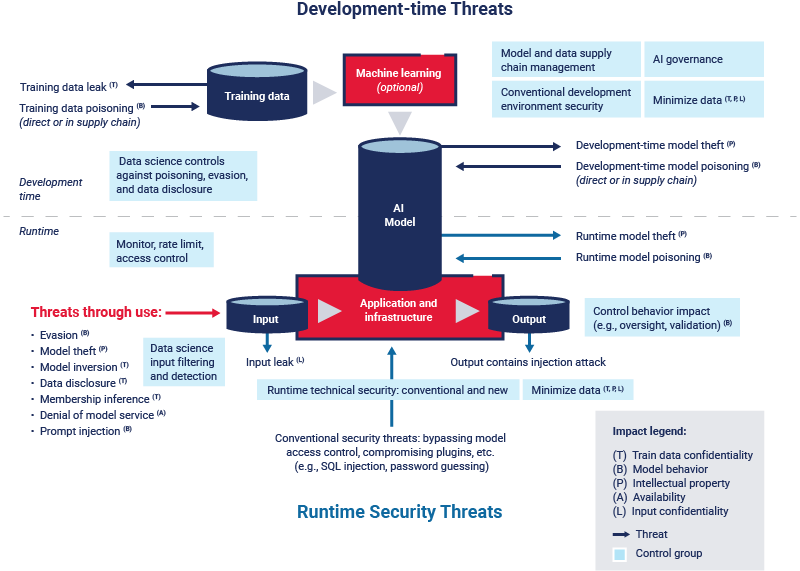
Besides the general AI risk that should be addressed through governance, according to the OWASP AI Exchange, AI threats fall into three major attack surfaces:141
Development-time threats (figure 3.4) occur during the development of the AI system. Attack surfaces include the engineering environment and the supply chain.142
Figure 3.4—Development-time Threats
Source: AI Threat Model by Software Improvement Group, donated to AI Exchange, free of copyright and attribution.
Runtime application security threats are attacks that occur due to security weaknesses that are not AI-specific. AI systems are also IT systems, so common IT vulnerabilities associated with software wrappers or other IT infrastructure used to host an AI solution should be considered.143
AI threats through use occur during normal activities associated with the use of an AI model, particularly input and output activities.144
During the development of an AI solution, data can be leaked or stolen from the training environment or data store. This can occur because of weak access controls in one or more systems that are in the data supply chain for the development of the model. It can occur at the originating data source, at the platform where data cleansing or preprocessing is performed, or at individual development environments, like Jupyter Notebooks.
While data access is limited to authorized data scientists and engineers, the training platform may not have implemented data exfiltration controls to prevent users from accidentally or maliciously copying data outside of the authorized training platform.
For example, popular interactive coding and computing platforms, such as Jupyter Notebooks and Google Colab, allow data scientists to document and run Python code to explore, process, and perform other data science tasks. Real data may be pulled into these environments, and the code and outputs (with real data) can be saved locally or in cloud computing environments, creating data sprawl and allowing data leakage. It is difficult to prevent and detect such scenarios, because a simple line of Python code can easily exfiltrate data outside of the organization’s control. Robust controls, including infrastructure and networking access controls, paired with application-level monitoring, need to be designed and implemented to address this new threat vector.
Malicious or erroneous data inserted into datasets with the intent of changing an AI model’s output behavior is called data poisoning. For large datasets, it is challenging to discern poisoned data from good data. There are multiple entry points where poisoned data can be introduced into the training dataset, including:
Data poisoning can lead to two key categories of risk impact: 1) creation of a backdoor or Trojan horse to modify a model’s specific behavior or output or 2) sabotage of the model to undermine safety, trust, or performance.
There are three potential methods for poisoning an AI model: 1) poisoning the data; 2) directly changing the model’s parameters, architecture, or libraries used for training; and 3) poisoning the model from a model supplier, if an organization uses a third-party, pretrained model for further training or fine tuning.
In order to change a model’s parameters, architecture, or libraries, an attacker would need to access the development or production environments to manipulate the source code, configurations, or other components used to train the model. Access controls should be put in place and reviewed regularly to prevent this type of attack.
The development of an AI model is a significant investment for many organizations, sometimes costing millions of dollars; therefore, enterprises aim to protect this form of intellectual property (IP) or proprietary information. Stolen AI models can be used to learn how the models behave to develop further adversarial attacks against them.
At its simplest form, an AI model is a mathematical algorithm that has been designed with a certain architecture (e.g., transformers, generative adversarial networks [GANs], recurrent neural networks) and weights of the features derived from data. The model is represented as source code files, configurations, and binaries. To steal a model, an attacker would need to gain access to the system (or code repository) in which the files and binaries are stored or loaded into memory, usually through query-based attacks.
An AI model can also be stolen during runtime or through use if the attacker does not have direct access to the model source code, binaries, and configuration file. By sending specifically crafted input to the model under attack and analyzing the resulting output, the attacker can infer the model’s parameters, features, and even the training data used. The attacker is then able to reconstruct a copy of the model.
A prompt injection is an adversarial attack against a GenAI model. This type of attack uses specifically crafted text prompts that provide specific instructions to the AI model. It is often designed to get the model to ignore certain aspects of the original instructions and follow the attacker’s instructions instead. It is similar to the classic Structured Query Language (SQL) injection attack on databases. Prompt injections are popular because they are easy to execute and do not require additional privileges to access the system or data. They instead use the available AI solution user interface or application programming interface (API) calls that are normally provided. An indirect prompt injection can also be executed when the model ingests malicious instructions from another data source (e.g., ground into the prompt via RAG).
Prompt injections can be mitigated by leveraging prompt templates that force structure and allow for sanitization of the original prompt. Prompts that fall outside of the defined parameters are rejected or adjusted before they are fed into the model for inference. Similarly, prompt injections can be mitigated during runtime processing when unapproved or inappropriate outputs are prohibited despite the prompt instructions.
Model evasion occurs when an attacker modifies the data specifically to circumvent the correct prediction of an AI model and cause errors. This leads to misclassification, misdetection, or some other unintended behavior. For example, an attacker learns the features and tolerances in an automated email protection system and modifies a malicious email’s contents to be erroneously perceived as safe by the system.145 The malicious email is then misclassified by the AI model as “safe” because the email contents contain key elements that result in a high safety rating.
Whereas model evasion is intended to fool the model, model inversion occurs when an attacker tries to extract sensitive or private information from the model. The attacker studies the model’s data input and resulting output, makes tweaks to the data input, observes the model’s response to those changes, and infers the model’s inner workings. The attacker can train a separate AI model that takes the output of the AI model under attack and deduces what the original input data was. Through numerous attempts and systematic optimization, the attacker can invert the model’s function.
Through model inversion, the attacker can infer sensitive attributes about the data used in the training of the model under attack (attribute inference), infer whether a specific data record is contained in the training dataset (membership inference), or reconstruct a high-quality copy of the training dataset.146 Mitigation approaches include applying differential privacy techniques to protect sensitive data used in training.
Many organizations may not have the resources (e.g., technical talent, computing resources, finances) to train or fine tune their own AI models. Vendors can bear the burden of training and supplying their AI models and solutions in the hope of recuperating those costs and making a profit through sales to customers. Those vendors also bear the responsibility of securing their AI models and solutions from AI-related threats.
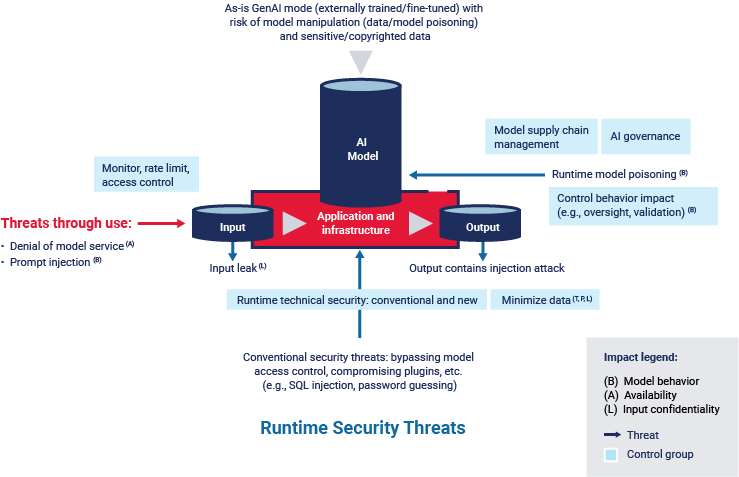
The OWASP threat model (figure 3.5) adapts the AI security threats and controls for scenarios where an organization is using a GenAI model out of the box (OOTB).
Figure 3.5—OWASP Threat Model
Source: OWASP AI Exchange, “AI Security Overview,” link
As AI becomes more pervasive in daily life, enterprises and individuals are becoming more dependent on the availability of AI solutions. An attacker can wreak havoc by sending either a large volume of inference requests for the AI solution to process or by sending computationally intensive inference requests. These tactics can result in a denial of service (DoS) or degradation of the AI solution.
The accelerated adoption of AI presents new layers of threats that cannot easily be addressed using a traditional technical approach. Ethical concerns cannot be patched, and there is no hot fix for biased decision making. Also, these areas may not be covered by existing risk assessment procedures. Therefore, enterprises must be aware of nontechnical AI threats (figure 3.6) so they can be included in the risk management process.
Figure 3.6—Nontechnical Threats
| Category | Threat | Description |
|---|---|---|
| Ethical concerns | Hallucinations | System generating misleading, harmful, or false content |
| Bias and fairness | Bias amplification | Artificial intelligence (AI) models reinforcing societal inequalities |
| Dependency | Overreliance | Users assuming decisions and information are infallible |
| Workforce impact | Job displacement | Replacing humans in the decision-making process; Replacing human roles altogether |
| Societal and cultural impacts | Societal manipulation | Deepfakes; Automated misinformation; Content inauthenticity and fake media; Voice cloning |
| Financial risk | Compute costs | Cloud/compute expenses required for AI workloads |
| Staff competency | Skill gaps | Shortage of AI-trained professionals |
| Brand and reputation | AI scandals | Unethical, biased, or harmful decisions that lead to mistrust and financial losses |
| Regulatory and compliance infractions | AI-specific regulations | Strict AI transparency and bias laws (e.g., EU AI Act) |
| Lack of transparency and explainability | Black box problems | Inability to explain AI-driven decisions |
| Strategic misalignment | AI hype adoption | Adding AI to products without real business value |
| Consumer distrust | Deceptive concerns | Fear of manipulated content; AI-driven fraud |
| Legal violations | Legal risk | Bias in hiring AI; Facial recognition lawsuits; Contractual agency; Criminal negligence |
| Privacy intrusion | AI-specific privacy concerns | Facial recognition; AI-powered surveillance |
| Market manipulation and abuse | Market manipulation | Algorithmic trading exploits; Dynamic pricing abuse |
| Rogue AI behavior | AI unpredictability | Self-learning models making harmful decisions |
| Cybercrime | Autonomous attacks | AI-generated phishing; Deepfake scams |
| Environmental and sustainability concerns | Excessive power and water consumption | High energy demand from training AI models, decreasing availability for consumers; High demand of water supply to cool servers needed for generative AI (GenAI) queries |
| Global geopolitical and trade restrictions | Export controls | AI chip and algorithm restrictions in global trade |
| Human-machine collaboration challenges | Trust issues | User misunderstandings or misinterpretations of AI outputs |
| Content inauthenticity and fake media | Deepfakes | Fake media; Voice cloning; Automated disinformation |
Source: ISACA, ISACA AAISM Official Review Manual, USA, 2025
Threat modeling is an important part of the risk analysis process, as it is important to identify the variety of actors associated with a given scenario (not necessarily with the same level of rigor as attribution, although positive attribution can accelerate the process).
It is important to understand which controls are successful at defending against the attacks or errors associated with various threat communities. In some cases, controls may address threats from more than one source. For example, the same control that addresses nation-state-sponsored attacks may also defend against cybercriminals. Overlapping controls in this sense should be noted in the threat model.
In general, threat modeling will:
Additionally, it will provide high-level answers to basic questions, such as:
Several threat modeling methods can be combined to create a more robust and well-rounded view of potential threats. Not all methods are comprehensive; some are abstract, and others are people centric. Some methods focus specifically on risk or privacy concerns. These methods can also be leveraged by AI agents to automate some components of the threat modeling process with human oversight. Figure 3.7 provides a list of threat modeling methods.
Figure 3.7—Threat Model Methods
| Model | Benefits | AI Considerations |
|---|---|---|
| STRIDE (Spoofing identity, Tampering with data, Repudiation, Information disclosure, Denial of service, Elevation of privilege) |
|
|
| PASTA (Process for Attack Simulation and Threat Analysis) |
|
|
| LINDDUN (Linkability, Identifiability, Nonrepudiation, Detectability, Disclosure of information, Unawareness, Noncompliance) |
|
|
| Trike |
|
|
| VAST (Visual, Agile and Simple Threat) |
|
|
| OCTAVE (Operationally Critical Threat Asset and Vulnerability Evaluation) |
|
|
| MAESTRO (Multi-Agent Environment, Security, Threat Risk, and Outcome) |
|
|
Source: Data from ISACA, CRISC Official Review Manual, 8th Edition, USA, 2025; Huang, K.; “Agentic AI Threat Modeling Framework: MAESTRO,” CSA Blog, 6 February 2025, link
As noted above, it is important to adapt existing threat modeling techniques to include considerations for ethics, privacy, and human rights, which are not commonly included in traditional IT risk and threat assessment.
As with many areas of IT and cybersecurity, use cases are evolving for the use of AI to assist with many risk management tasks, including threat modeling. Tools, such as STRIDE GPT and Irius Risk, leverage AI to help teams create risk and threat scenarios based off common frameworks.
The use of AI in threat modeling represents a significant advancement in automating and augmenting traditional risk identification and assessment activities. AI technologies can enhance the efficiency, accuracy, and adaptability of threat modeling by generating detailed threat profiles, simulating complex attack paths, and identifying emerging threats in dynamic environments.
AI can assist in creating and maintaining comprehensive threat profiles by analyzing vast amounts of data related to threat actors, their motivations, methods, and skills. By leveraging natural language processing (NLP) and machine learning (ML) techniques, AI tools can extract relevant information from diverse sources such as threat intelligence feeds, security reports, and incident logs. This automation supports the continuous updating of threat profiles, ensuring that organizations maintain an up-to-date understanding of the threat landscape relevant to their AI systems and broader enterprise assets.
AI-driven simulation models enable the exploration of potential attack paths by mapping adversarial tactics, techniques, and procedures (TTPs) against system architectures and vulnerabilities. These simulations can incorporate AI-specific threat considerations, such as adversarial ML attacks, data poisoning, and prompt injection attacks, which traditional threat modeling methods may not fully address. By integrating AI capabilities, organizations can generate more realistic and complex threat scenarios that reflect the evolving nature of AI-enabled attacks.
The dynamic and rapidly evolving AI threat landscape requires continuous and adaptive threat modeling. AI-powered tools can analyze patterns and anomalies in security telemetry, user behavior, and external threat intelligence to detect novel or emerging threats that may not be captured by static threat models. This proactive identification supports timely risk mitigation and informs strategic decision making.
Using AI for threat modeling offers several benefits, including scalability to large and complex systems, improved accuracy through data-driven insights, and the ability to adapt to new threat vectors rapidly. However, organizations must ensure that AI-assisted threat modeling incorporates ethical, privacy, and human rights considerations, which are often underrepresented in traditional models.
Human oversight remains essential to validate AI-generated threat models, interpret results in context, and make informed risk management decisions. The combination of AI automation and expert judgment creates a robust approach to managing AI-related risk effectively.
Constructing detailed AI risk scenarios is a critical step in understanding and managing the complex and evolving risk associated with AI systems. An AI risk scenario serves as a practical tool for communicating risk effectively to business process owners and stakeholders, enabling informed decision making aligned with organizational goals.
An AI risk scenario includes:
To be effective, AI risk scenarios must be relevant and realistic, reflecting the organization’s specific context and risk appetite. Scenarios should be directly linked to the enterprise’s objectives and priorities, ensuring that risk management efforts focus on events that could materially affect business outcomes. This alignment helps avoid an overwhelming number of hypothetical “what if” scenarios and instead concentrates resources on high-impact, plausible risk.
Developing AI risk scenarios benefits from a balanced approach that leverages both historical incidents and emerging AI threats. Historical events provide a foundation for understanding known vulnerabilities and attack patterns, enabling organizations to prevent recurrence and improve resilience. However, exclusive reliance on past events is insufficient given the rapid evolution of AI technologies and threat landscapes. Scenarios must also anticipate novel risk, such as those arising from GenAI misuse, prompt injection attacks, or systemic AI failures, to prepare the organization for future challenges.
The process of developing AI risk scenarios typically involves:
AI, GenAI in particular, can be leveraged to aid in the development of risk scenarios for risk management. GenAI and LLMs can process large amounts of data in a short amount of time, making them useful for scanning threat and risk reports and scraping news sites for details regarding emerging threats.147 AI can also enable risk management teams to focus more on decision making, as the data analysis piece of risk scenario creation will be automated. These insights can be leveraged to create more robust risk scenarios. AI-enabled risk scenario development has been found to be of particular benefit for regulatory and compliance management.148
For example, a study was conducted where a multiagent system was used to search over 100,000 news sources using a Boolean query created by an LLM.149 The result of the search was 39 relevant news articles. Then, LLM prompts were used to chunk and analyze the data in the articles to define an “influence event”—a summary of the title, description, and actors in the article that may be relevant to the search query. This data was further classified based on relevance. After this review, nine events were identified and then further processed to create 37 projections based on these events. The projections were fed into the LLM again in pairs, analyzed, and used to create risk scenarios.150
The limitations of using AI for risk scenario generation are similar to any use of AI solutions (e.g., hallucinations). They include bias in training data scraped from external and news sources, data privacy concerns, and technical/skill limitations, such as creating prompts to derive a Boolean query (as in the example).
As with other technology risk, the enterprise will need to establish categories of AI risk based on its objectives and strategy. The enterprise will also need to review what level of risk it is willing to accept related to the use of AI, as it may differ from existing risk tolerance and appetite levels.
Various factors can inform these decisions.
Risk classification categories continue to evolve and mature over time as advancements are made in the field of AI and risk. Enterprises can leverage existing risk taxonomies and evaluate if they are robust enough to cover risk related to AI. Risk management can also look to the growing body of AI risk taxonomies and classification categories suggested by academic, institutional, and governmental bodies.
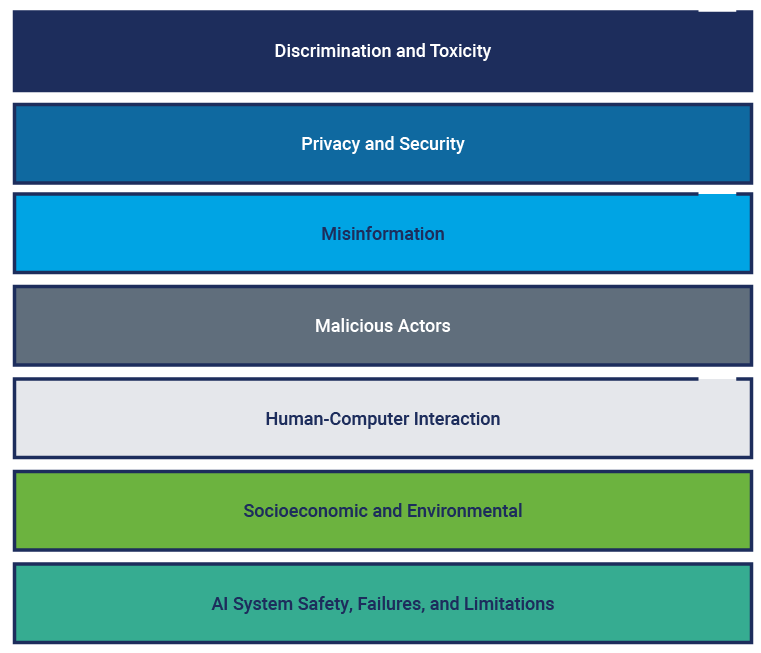
The MIT AI Risk Repository is a living database of over 1,600 AI risk areas, which have been categorized based on causal and domain-level taxonomies.151 The purpose of the repository is to provide a common vocabulary and frame of reference for discussing AI risk.
The causal taxonomy of AI risk is shown in figure 3.8.
Figure 3.8—MIT Causal Taxonomy of Risk
| Category | Level | Description |
|---|---|---|
| Entity | AI | The risk is caused by a decision or action made by an AI system. |
| Human | The risk is caused by a decision or action made by humans. | |
| Other | The risk is caused by some other reason or is ambiguous. | |
| Intent | Intentional | The risk occurs due to an expected outcome from pursuing a goal. |
| Unintentional | The risk occurs due to an unexpected outcome from pursuing a goal. | |
| Other | The risk is presented as occurring without clearly specifying the intentionality. | |
| Timing | Predeployment | The risk occurs before the AI is deployed. |
| Postdeployment | The risk occurs after the AI model has been trained and deployed. | |
| Other | The risk is presented without a clearly specified time of occurrence. |
Source: MIT, “The MIT AI Risk Repository,” link
The seven domains covered in the domain taxonomy of AI risk are shown in figure 3.9.
Figure 3.9—MIT’s AI Risk Domain Taxonomy
Source: MIT, “The MIT AI Risk Repository,” link
The EU AI Act identifies risk categories to provide organizations with an easy way to understand what kind of risk is permissible and what must be managed more rigorously:152
This simplistic, qualitative view of risk categories may provide a suitable classification system for enterprises that are less dependent on the financial or quantitative impacts of AI.
The Factor Analysis of Information Risk-Artificial Intelligence Risk (FAIR-AIR) Approach Playbook leverages the FAIR risk management framework and translates AI-related risk into financial terms. This enables effective communication about risk to senior leadership and other relevant stakeholders.153 Compliance-driven enterprises can map FAIR-AIR outputs to jurisdictional regulatory frameworks like the EU AI Act.
Figure 3.10 shows the five steps in the FAIR-AIR approach to risk classification.
Figure 3.10—FAIR-AIR Approach

Source: Adapted from FAIR Institute, FAIR-AIR Approach Playbook: Using a FAIR-based Risk Approach to Expedite AI Adoption at Your Organization, link
The FAIR-AIR approach allows organizations to classify and determine if AI-related risk is within acceptable limits or if it exceeds defined thresholds. These standard risk classification processes include:
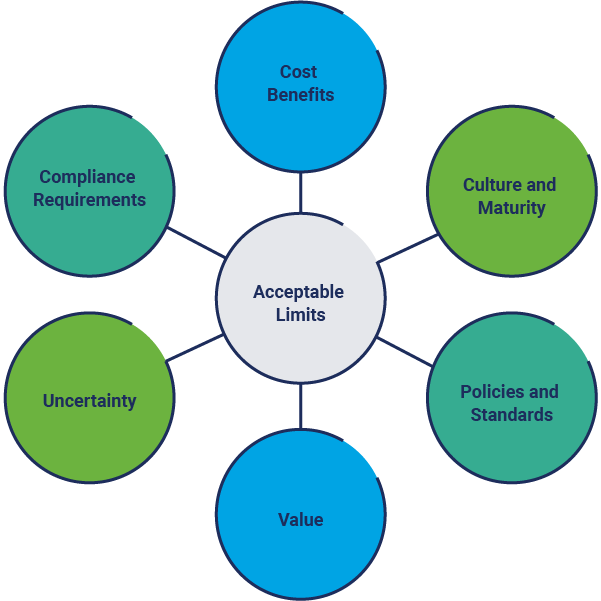
An organization’s owners and/or governing body are ultimately responsible for establishing its risk appetite and tolerance criteria. Defining acceptable limits requires a balancing act that considers multiple influences. Figure 3.11 shows some of the factors that should be considered when establishing acceptable limits.
Each organization needs to consider what risk it is willing to accept and identify compliance requirements (e.g., EU AI Act, the Health Insurance Portability and Accountability Act [HIPAA], General Data Protection Regulation [GDPR], etc.) that may compel them to demonstrate conformance with a set of obligations.
Figure 3.11—Determining Acceptable Limits
Source: ISACA, ISACA AAISM Official Review Manual, USA, 2025
Acceptable levels of risk are established as part of an organization’s defined information security strategy, with management determining acceptable risk levels, normally defined by the losses the organization is willing to accept in pursuit of its goals and objectives. Other rationales for acceptable levels of risk include enterprise risk appetite and tolerance levels.
In many ways, AI risk is the same as all other risk the enterprise faces. Therefore, AI risk should be integrated into existing risk assessment processes. Risk assessments should be performed on a regular basis and during any changes to AI solutions. Leveraging the organization’s current definitions for risk can be a good starting point to assess the likelihood and impact of identified risk to the organization. Special considerations for the unique attributes of AI solutions should be documented within the process. If these attributes are not present in current risk assessment processes, the organization should update the processes accordingly.
Specific risk assessment considerations for AI solutions include:154
Risk assessment for AI solutions follows many of the same approaches as other IT implementations. However, the use of AI presents a level of nontechnical risk considerations that may be new for many enterprises, such as considerations of ethics, bias, fairness, and human rights (see Part F: AI Trustworthiness, Ethical, and Societal Implications for more information). In some cases, it is best to use a hybrid risk assessment that combines quantitative financial loss estimates and qualitative evaluation of ethical/social AI risk. Additionally, the large amount of data used to train and operate AI solutions raises numerous privacy concerns.
These emerging areas of risk may seem difficult to quantify and analyze, but many traditional risk assessment methodologies can be applied to these areas to help enterprises assess and prioritize AI-related risk.
Quantitative risk assessments tend to be the most useful in risk analysis, as they provide stakeholders with concrete loss information, typically in the form of financial impacts. For AI, existing procedures should be identified to determine the financial impacts of AI system failures.155
Impacts of data loss and leakage as well as traditional IT and cybersecurity concerns, such as system downtime and loss of productivity, can be quantified for AI risk scenarios. Increased data storage needs and utility demands can also be measured.
As noted, AI presents unique areas for consideration, namely in the ethical, societal, and environmental impacts its use can have. These areas may also be more difficult to quantify and may have more significant impact on an enterprise’s reputation and trustworthiness. Segmented global, regional, and industry standards and regulations mean that the risk of an ethical incident can have varied impact depending on where it occurs.
Faults in AI solutions, such as bias and discrimination, can potentially harm humans. Most commonly, this harm relates to privacy, data protection, and equality. Infringement of human rights can lead to reputational damage for AI users (e.g., companies, individuals) and potential litigation and related financial risk.
Before deploying any high-risk AI system (one that poses a significant threat to the health, safety, or fundamental rights of individuals), especially one used by public bodies or private entities providing public services, the EU AI Act requires a fundamental rights impact assessment (FRIA). This evaluation is designed to ensure that the system does not negatively affect an individual’s rights.
At a high level, the assessment process involves:156
The assessment must be completed before the AI system is first used and must be updated if any conditions change. The findings must be submitted to the appropriate regulatory authority.
The goal of the assessment process is not only to safeguard and protect the fundamental rights of humans affected by the use of AI but also to ensure transparency, accountability, and fairness in AI solutions. While similar to a FRIA, a data privacy impact assessment (DPIA), as required by the GDPR, does not fully cover the scope of the rights mandated by a FRIA, as FRIAs are broader in scope and should be conducted in addition to DPIAs where both apply.
Conformity assessments demonstrate how AI systems are compliant with regulations, specifically the EU AI Act. These assessments evaluate both a provider’s quality management system and technical documentation. Under Article 43 of the EU AI Act, evidence that an assessment was performed is required for all high-risk AI systems,157 with new assessments required after any substantial modifications.
While mandated by the EU AI Act, this assessment is useful for any enterprise implementing an AI solution. A conformity assessment can be thought of as a safety check for high-risk AI systems. It helps to ensure that AI systems are built and operate in accordance with the defined requirements and rules needed to protect an individual citizen’s safety, rights, and overall well-being.
Based on the type of system and the standards used, this assessment can be performed by the provider’s organization or through the external review by an independent expert. The system’s design, performance, and management processes need to be documented and carefully examined. The goal of this process is to build trust, ensure the system is reliable, and minimize risk before the AI system is used.
The conformity assessment ensures that an AI system meets regulatory and technical standards before and after deployment. Its processes are focused on the provider organization’s quality management system, technical documentation, and ongoing surveillance. Its goals are to mitigate risk, enhance transparency, and build trust in AI systems.
A privacy impact assessment (PIA) is an analysis of how personal information is collected, used, shared, and maintained for a specified scope of consideration. PIAs, referred to as DPIAs under GDPR, are structured processes for identifying and mitigating privacy risk, including risk to confidentiality. Their scope may span physical processes, administrative processes, technical processes, or a combination of these. In AI systems, specific risk such as inference attacks, reidentification through model outputs, and cross-dataset linkage must be considered when conducting PIAs.
At a high level, a PIA has four general goals:
A PIA should be performed using a methodology that is established through a government or industry standard or regulation. Using a methodology ensures that the PIA process is repeatable and can be consistently performed from one PIA to the next.
New PIAs should be conducted whenever there is a change that is likely to involve a new use for personal data or significantly change the way it is handled, such as through implementation of new types of technologies, including AI solutions.
While traditional privacy risk focuses on unauthorized access, data breaches, and regulatory noncompliance, AI introduces additional concerns. AI-driven privacy risk includes algorithmic bias (unintentional discrimination against certain groups), inference-based privacy risk (inference of sensitive personal details beyond those explicitly provided), and lack of explainability in AI-driven decision making, all of which make it difficult to audit privacy compliance. These factors must be considered when conducting PIAs for AI systems.
AI systems often use data from other locations within or external to the team developing and using the solution. It is important to ensure that data protection principles applied to data at its original location persist to its new location in the AI solution.
Since a key part of risk assessment is analyzing large amounts of data, AI can be a powerful tool to assist in the process. LLMs can be used to review interview data, summarize key risk considerations, and provide quantitative analysis of likelihood and impact.158
Benefits of using AI for risk assessment are similar to the benefits seen in other AI use cases. These include automated monitoring and reporting, increased efficiency, the ability to identify and predict risk in emerging areas, and cost savings, among other areas.159 Likewise, limitations include ensuring the use of high-quality, unbiased data in predictions and common AI-related concerns, such as fairness and transparency, skills of existing employees to use AI, and regulatory and compliance concerns.
Best practices for using AI for risk assessment include:160