Figure 3.18—MITRE ATLAS
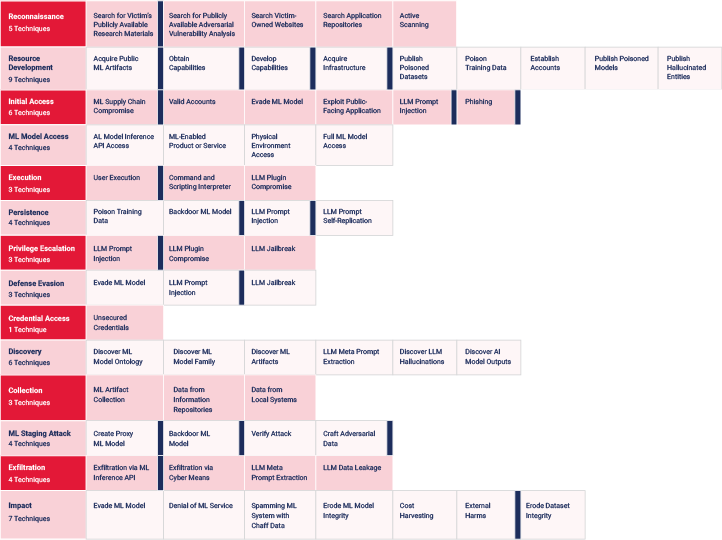
Source: MITRE, “ATLAS Matrix,” link
Controls for AI assets and systems are essential to ensure their proper development, training, deployment, operation, and decommissioning. Controls span governance, technical, procedural, personnel, physical, and ethical measures, ensuring the security, reliability, compliance, and responsible use of AI systems. Controls may cross multiple organizational areas.
Existing technical and nontechnical controls may need to be expanded, and new controls may need to be introduced with the use of AI. The enterprise’s established control framework will need to be updated to account for AI concerns. AI-specific controls may be similar to privacy and cybersecurity controls, with coordination, technical configuration, monitoring and auditing, and upgrading controls combined to contribute to the holistic effectiveness and sustainability of protection measures across several domains.
As with cybersecurity, no single area is responsible for AI controls. Behavior is guided through policy, standards, and procedures. Technical architectures and requirements are designed to prevent or reduce the impact of a threat being realized. Monitoring and continuous improvement will identify negative or unwanted events and adjust to minimize or remove the impact of them.
Common types of AI controls are listed in figure 3.15.
Figure 3.15—Common Types of AI Controls
| Control Category | Controls | Explanation |
|---|---|---|
| Governance and Organizational | Accountability (e.g., RACI chart, accountability matrix) |
|
| Executive-level role | Appoint a chief data officer (CDO), chief AI officer (CAIO), or other function as the accountable manager and committee head. | |
| AI policy |
| |
| Standards and frameworks | Several frameworks and standards are available for organizations to implement, providing structure and baseline categories of responsibilities for the development, management, risk management, and oversight of AI systems. | |
| AI asset management | Creating and maintaining an AI registry with details of all models, including details such as purpose and goals, stakeholders, outcomes, versions, and life cycle management. | |
| Risk management |
| |
| AI legal contracts and agreements | Contract management needs to ensure that vendors and partners meet obligations that support the organization’s adherence to AI laws and regulations. For example, organizations may not have needed to address consent previously when interacting with data but may now need to consider or secure it in order to train AI models. | |
| Technical, Security, and Privacy | Data quality | Document definitions for:
|
| Access controls |
| |
| Configuration management |
| |
| Testing frameworks and protocols |
| |
| Privacy |
| |
| Data management |
| |
| AI incident management |
| |
| Operation and Life Cycle Management | Dataflow diagrams (DFDs) and process flow documentation |
|
| AI decision-making documentation |
| |
| Applicable standards | Change management (including updating and patching) | |
| Version control and version (code) management |
| |
| Change management |
| |
| Continuous monitoring and logging |
| |
| Systems Development Life Cycle (SDLC) | Project management |
|
| Ideation phase |
| |
| Design phase |
| |
| Deployment management |
| |
| Legal, Compliance, and Regulatory | Risk and impact assessments |
|
| Fundamental rights impact assessment (FRIA) | For organizations that have systems classified as high risk under the EU AI Act, a FRIA must be conducted. These systems are considered to have an impact on human rights, safety, or potentially health. These include:170
| |
| Legal and regulatory |
| |
| Risk management |
| |
| AI legal contracts and agreements | Contract management needs to ensure that vendors and partners meet obligations that support the organization’s adherence to AI laws and regulations. For example, organizations may not have needed to address consent previously when interacting with data but may now need to consider or secure it in order to train AI models. | |
| AI whistleblower process |
| |
| Regulatory reporting and decision making |
| |
| Ethical and Human Values | Ethical impact assessment (EIA) |
|
| Consent management |
| |
| Bias management |
| |
| Transparency and explainability |
| |
| Human oversight |
|
Source: ISACA, ISACA AAIA Official Review Manual, USA, 2025
While the field is still evolving, some organizations have published, or are in the process of publishing, AI control frameworks, including:
Enterprises can leverage this guidance to find controls that work to mitigate risk in AI systems and tools that are deployed, used, or leveraged.
As AI solutions are often built on or integrated into existing networks and infrastructure, it is important to evaluate the effectiveness of existing controls to see if they are adequate for addressing the complex needs of AI solutions.
When enterprises purchase AI solutions or select a vendor to provide part or all of an AI solution, careful review of the vendor’s preset security options and controls is necessary to determine if they are adequate and support the enterprise’s risk appetite and tolerance levels. See 3.17 AI Vendor Management for more information.
An important first step when determining what controls are needed for AI solutions is to identify any gaps in existing controls that are created by the risk presented by the use of AI. This begins with evaluating what controls already exist in the enterprise and where the primary controls are insufficient, ineffective, or infeasible to implement.
Control gaps represent the disparity between the current state of controls and the desired state necessary to maintain risk within acceptable levels. A thorough control gap assessment begins with an accurate understanding of the current control environment, which can be established through various sources such as audits, control tests, incident reports, vulnerability assessments, and direct observations. This assessment provides a baseline for identifying weaknesses or deficiencies in the control framework that may expose the organization to unacceptable AI-related risk. For example, a database of customer information is properly secured by the marketing team, but when the data is shared with the development team, they discover that the new database lacks proper access controls.
Once these gaps are identified, the enterprise can evaluate what adjustments need to be made to existing controls or what controls may need to be developed to address new risk areas not previously addressed by these existing controls.
When primary controls cannot adequately mitigate risk—due to constraints such as cost, operational requirements, or technical limitations—alternative or compensating controls must be considered. These controls serve to offset the risk that cannot be directly addressed by the primary controls. Effective compensating controls are designed to complement existing controls without duplicating efforts or increasing the risk surface. Examples include layered defense strategies, enhanced supervision, increased audit frequency, and comprehensive logging of AI system activities.
The process of implementing alternative controls requires careful design and selection to ensure they align with organizational risk appetite and operational realities. For AI systems, compensating controls might include additional monitoring of model behavior, stricter access controls on training data, or human oversight mechanisms to review AI outputs when automated controls are limited.
Once alternative controls are identified and implemented, their effectiveness must be validated through testing and continuous monitoring. See Part D: AI Risk Metrics, Monitoring, and Reporting for more information.
AI control evaluation must be aligned with the organization’s broader risk management frameworks and policies. This alignment ensures that AI controls support enterprise risk appetite and tolerance levels and comply with applicable legal, regulatory, and ethical standards. The evaluation process should verify that AI controls are integrated with existing governance structures, such as risk committees and audit functions, and that accountability for AI risk management is clearly assigned. Furthermore, controls should be assessed for their compliance with AI-specific requirements, including DPIAs, FRIAs, and ethical impact assessments (EIAs), especially for high-risk AI systems.
Validating AI controls ensures that risk mitigation measures are functioning as intended and that AI systems operate securely, reliably, and ethically. Given the dynamic nature of AI models and data, validation must be iterative and adaptive, incorporating feedback from monitoring and audit findings to continuously improve the control environment. It should also occur during major AI life cycle events (e.g., after model retraining, data updates, or architecture changes) to confirm that control effectiveness remains consistent, and adversarial robustness testing should be conducted to ensure AI systems can withstand malicious inputs and manipulation attempts.
Once controls are selected, they should be tested to ensure they are implemented properly to manage risk to acceptable levels. Testing helps to confirm that controls meet their design objectives and comply with organizational policies and regulatory requirements. Techniques include:
Validation requires ongoing monitoring to detect control degradation or emerging risk. Continuous monitoring includes:
Maintaining detailed documentation of control implementation, testing results, and monitoring activities is essential for validation. This includes:
Independent assessments by internal or external auditors provide an objective evaluation of control effectiveness. Auditors validate that controls are implemented as designed and are effective in mitigating AI risk. They also assess whether controls align with relevant frameworks, standards, and regulations.
Controls can lose effectiveness over time. This is especially true with AI solutions, as model performance can degrade with the introduction of new information. The rapid pace at which AI technologies are advancing along with a threat landscape that changes at the same, or an even quicker, pace emphasizes the need to ensure risk treatment strategies continue to perform as expected. Monitoring performance also enables enterprises to apply compensating controls or change control thresholds given this dynamic environment.
Effective control performance monitoring requires establishing clear processes and procedures aligned with enterprise objectives and risk management frameworks. This includes:
Data for monitoring should be collected from a variety of sources, including operational and security logs, security information and event management (SIEM) systems, network operations centers (NOCs), and testing results. The data must be validated for accuracy and integrity before analysis against performance targets. Advanced tools, including AI-based anomaly detection, can enhance the identification of control failures or unusual behavior indicative of risk.
When monitoring reveals control deficiencies or noncompliance, the risk practitioner should collaborate with control owners to recommend and implement mitigation measures. These include:
Control performance monitoring should be iterative and adaptive, reflecting changes in the AI risk environment, emerging threats, and organizational priorities. Regular self-assessments by control owners foster ownership and accountability, while independent assurance reviews provide objective validation of control effectiveness. All monitoring activities and management acknowledgments should be documented in the risk registry to maintain transparency and support audit readiness.
As noted, AI solutions may use many of the same controls that other IT and network implementations currently use within the enterprise. At the same time, AI solutions can often be more complex; for example, a group of multiple AI agents is deployed to aid a customer service team as the first contact for a retailer. Each of these agents is a separate LLM that needs to be monitored for performance.
Data protection and privacy concerns also play a role in AI risk, and many enterprises may need to deploy more sophisticated controls around this area.
In addition to technology architecture, AI introduces nontechnical risk (see 3.1.2 Nontechnical Threats for more information) that requires implementation of specialized controls.
Common AI-related data privacy controls are listed in figure 3.16.
Figure 3.16—Common AI-related Data Privacy Controls
| Control | Description |
|---|---|
| Data privacy and handling protocols | Implement and document protocols and practices for data handling, ensuring data encryption, anonymization, and access controls. |
| Artificial intelligence (AI) data retention and encryption protocols | Deploy encryption techniques and define and implement clear data retention timelines to bolster AI data security. |
| Privacy-first data handling | Ensure models handle data with privacy as a priority, especially when regulatory changes might impact operations. |
| Differential privacy | Ensure the model does not leak individual training data information. |
| Privacy enhancing technologies (PETs) | Integrate technologies that enhance user privacy into AI systems, ensuring that data is protected and privacy standards are met or exceeded. |
Source: ISACA, Artificial Intelligence Audit Toolkit, link
Ethics are a major concern when adopting AI technologies; however, this is an area that is unfamiliar to many enterprises and the IT security teams who are accustomed to focusing on the technical side of an implementation. In general, there are two AI capabilities that make ethical considerations regarding its use different from other technical areas—automatic decision making and self-learning. Both of these AI attributes make it necessary to examine how AI’s autonomy from human involvement may create undue harm or risk to people.
Common ethics controls include:178
While concerns around how AI may cause physical harm to humans remain hypothetical, there are real considerations when it comes to automation and decision making carried out by AI algorithms and models.
For example, a grocery store uses a robotic machine to clean its floors. What security measures are in place when that machine encounters a shopping cart and a customer? What decisions has the robot been programmed to make on its own? The safety implications are numerous for the autonomy of objects to maneuver in the environment.
This extends to AI systems as well. Technological developments have started to provide AI with agency (e.g., the ability to act independently and make decisions). This has raised some ethical and philosophical questions, but there are more practical issues to resolve:
With AI gaining greater agency and autonomy, robust governance and increased supervision over AI outcomes are key. Figure 3.17 describes common controls related to AI supervision and safety.
Figure 3.17—Controls Related to AI Supervision
| Control | Description |
|---|---|
| Logging and monitoring | Deep learning (DL) models are the most complex to understand and explain, largely because of their large dataset sizes and high dimensional calculations. These complex models should be made transparent with detailed logging of their decision-making paths. This practice allows the artificial intelligence (AI) designer to see the input and output of each neural network (NN) path the model took through its “chain of thoughts.” Paired with the data input and resulting inferred output from the model, an audit log is created to aid in debugging and troubleshooting. |
| AI observability | AI observability practices and tools help ensure the availability, reliability, performance, and trustworthiness of the AI system. Categories of AI observability tools include:
|
| Human in the loop (HITL) | Ensuring a person oversees and monitors AI and makes final decisions related to the AI outputs is key to ensuring the safety and accuracy of AI decisions. |
For critical decisions and actions, another AI supervision strategy is employing a HITL control. For example, before a patient’s final diagnosis of a disease, a human doctor could be placed in the loop to review the AI model’s decision. This puts a human in the final decision-making role to approve the AI workflow. The workflow pipeline of the AI system must be designed and implemented to require a HITL for specified conditions and explicit approval before the workflow is allowed to continue.
The term AI in the loop (AITL) represents a paradigm shift from the traditional HITL approach, emphasizing a collaborative dynamic in which AI systems actively assist and augment human decision-making processes. In this framework, AI serves as a support tool, providing data-driven insights and recommendations, while humans maintain primary control over critical decisions.
While AI is being implemented as an access control itself, protecting access to data used for and created by AI needs additional consideration over typical access control policies.
An AI access control policy should include the authorization, integration, duration, and type of data to be accessed, with appropriate controls to ensure that access is protected for those who would normally not have access without the data being part of an AI model.
For example, a technical supervisor does not have access to employee HR records. However, employee records may be included in an internal AI model for staffing, utilization, etc. The same supervisor may be granted access to the same model for other analytics and model supervision. In this scenario, the supervisor may have access to data in the model that would be restricted in other situations.
Key considerations for AI access control include:
The concept of zero trust within a traditional security model is fairly clear-cut. Enterprises should never assume security unless verified. This is applicable to AI solutions, particularly regarding the model and the data used. Some traditional security zero trust concepts that can apply to AI include:179
Zero trust in AI requires additional safeguards for mixed data models (structured, unstructured, synthetic), ensuring that different data types are properly segmented and controlled.
Zero trust in AI means that decisions made by AI solutions are not automatically assumed to be correct.
In order to fully trust that an AI is making “correct” decisions, three key areas must be considered:180
One significant factor that affects AI solutions is its ability to access the internet, particularly in applications that are integrated with LLMs.
Some controls for this situation include:
Creation of an AI acceptable use policy (AUP) is a required security control for the organization to state the framework for ethical and responsible deployment and use of AI. It should provide clear guidance on usage that balances its benefits against risk. The policy should include expectations for the use of AI tools. Similar to a general AUP, the AI AUP communicates required and prohibited activities and behaviors. It is the big picture of what and why that establishes the intent about a particular topic, reflecting the broader goals, objectives, and culture of the organization. It is a tool to inform staff of expectations: what is and is not allowed.181 See 1.10 AI Acceptable Use Policy for more information.
Audits are a critical element for any technical implementation to ensure requirements and policies are being followed. Similar to access control, many organizations are using AI toolsets for automatic audits and traceability assurances. The human factor is still critical at this stage of an organization’s adoption of AI. The potential complexity of multiple layers of AI models, along with different groups using AI specific to their department, brings significant risk to the governance of AI.
Traceability in AI is the ability to track how data moves through the system and how it makes decisions. Traceability can be useful to verify the origin of data, processes, and other factors that are key to developing an AI model.182 Regular audits can help ensure traceability to avoid concerns around the black box nature of many AI models, especially proprietary models. Audits provide assurance, outside of the team that developed the model, that the algorithm and model are working as intended and suggest remediations for any findings related to lack of transparency or noncompliance.183
Metadata logging is another way to ensure traceability in AI solutions. Metadata provides information needed about AI models, outputs, inputs, and other details that help to ensure the trustworthiness of AI solutions.184 Model cards are one method used to record this information. See 2.4.2 Model Cards for more information. Software solutions are also available to help capture metadata related to AI models.
Shadow AI, the use of unapproved AI applications, has serious consequences. Shadow AI introduces significant risk, including accidental data breaches, compliance violations, and reputational damage. Shadow AI may also lead to direct violations of regulatory requirements (e.g., EU AI Act), exposing organizations to compliance penalties if unapproved systems process sensitive data. These unapproved applications should be identified, assessed, and either removed or integrated into the existing security architecture.
Guardrails need to be created to ensure AI applications and tools can be identified to reduce or remove the risk of proprietary data leaking into public domain models. Once proprietary data gets into a public domain model, more significant challenges begin for any organization. Consider these controls to identify and protect against shadow AI:185
Prompt templates, which are used to control data input into the AI model, standardize and sanitize instructions and limit the variety in which the model takes instructions. Prompt templates can be effective in preventing or reducing the risk of prompt injections.
Prompt templates can be used as an additional preprocessing step before the data input is fed into an AI model. The template also helps the model achieve higher output performance because of the standardization.
Adversarial testing of AI is similar to security red team or ethical hacking activities. By intentionally feeding malicious data inputs into the model, testers using adversarial testing techniques can elicit unexpected and incorrect responses from an AI system to test it and the underlying model’s resilience to malicious threat actors or edge case scenarios.
For a more thorough knowledge base of adversarial tactics and techniques, the MITRE corporation has developed the Adversarial Threat Landscape for Artificial-Intelligence System (ATLAS) to capture a knowledge base that can be leveraged by AI red teams (figure 3.18).186
See 2.7.2 Adversarial Training for more information.
Figure 3.18—MITRE ATLAS
Source: MITRE, “ATLAS Matrix,” link
Defensive distillation is a detection technique to guard against adversarial input to an AI model. This technique works by training two models—an original teacher model and a second distilled model, which is trained from the results of the teacher model and later used for inference. This allows the resulting distilled model to be more robust and resilient against an adversarial attack.
Regularization prevents the overfitting of an AI model. While it is often used to improve the model performance by generalizing well, regularization also helps in defending against adversarial attacks. Some attacks use small changes to data to infer a model’s features and the tolerances within which a prediction output could change. To prevent this type of attack, the regularization technique makes the boundaries less defined and less susceptible to inferential types of attacks.
AI can be a valuable tool for automating parts of the control management process. For control selection, AI can analyze historical data and provide suggestions on what types of controls are best suited to manage risk to acceptable levels.
AI automation takes over repetitive tasks like monitoring and scanning and can assist in analyzing data-heavy logs. Reduction in human error provides the security team with the space to focus on complex problem solving and strategic decision making.
For example, existing threat detection and response tools—such as SIEM; security orchestration, automation, and response (SOAR); and extended detection and response (XDR)—now leverage AI capabilities to enhance their functionality.187 UEBA also employs AI to help with detecting anomalous user behavior and analyzing large amounts of user data related to networks and IT assets.